Summary
GeoDirectory is a free plugin for creating directory and listings websites with WordPress. The core plugin can be enhanced by installing the free and paid add-ons, and there are also free and paid WordPress themes available for your directory website.
GeoDirectory is a free plugin for creating directory and listings websites with WordPress. The core plugin can be enhanced by installing the free and paid add-ons, and there are also free and paid WordPress themes available for your directory website.
Pros
Free core plugin
Lots of useful free and paid add-ons
Powerful set of features
Good selection of compatible themes
Highly flexible
Cons
Some might prefer an all-in-one directory theme and plugin combination
Cost of paid add-ons could get expensive, depending on your needs
Some of the themes don't look very modern
GeoDirectory is a free plugin that lets WordPress users build a fully featured directory and listings website, no matter what theme they're using.
Once enabled on your site, the free version of GeoDirectory gives you enough to get started. If a feature is missing from the core plugin, the library of free and premium add-ons for GeoDirectory can add the functionality your directory needs.
As mentioned, GeoDirectory works with any good WordPress theme. But if you haven't chosen a theme yet, there are a number of free and paid options from the GeoDirectory team built specifically for use with this plugin.
This also means that if you're building a directory website with WordPress, you don't have to choose a directory app theme to get the premium directory features needed to build a professional site of this type.
You can get started for free (provided you have hosting and a domain for your website), then pay to add extra features as and when you need them.
In this GeoDirectory review, we take a look at the features of the core plugin and the add-ons currently available for it. We also explore how easy it is to use, from both the admin and end-user perspectives, and whether it's the right tool for your website.
Quick verdict
GeoDirectory is one of the most powerful plugins for building business directories and listings sites on WordPress. The core plugin is free, and a library of premium add-ons lets you add exactly the features your project needs.
- Best for: local business directories, city guides, real estate listings, job boards, and classifieds
- Standout features: single and multi-location support, Google Maps integration, front-end submission forms, and custom database tables built for performance
- Pricing: free core plugin; premium add-ons from $29 per year, or all of them bundled at $229 per year
GeoDirectory is built to scale, so it suits everything from a small local directory to an enterprise listings platform. You'll likely need a couple of paid add-ons for a fully featured site, which is the main cost to plan for.
GeoDirectory features

To give you an idea of whether this is the right plugin for your project, here's a look at the main features of GeoDirectory.
Some of these features are in the free version of GeoDirectory, while others are available as paid add-ons. We cover the pricing details later in this review, but you can get all of the add-ons for one reduced price through the membership bundle, rather than buying them individually.
Under the hood, GeoDirectory stores its listings in custom database tables rather than standard WordPress post meta. That's a key reason it can handle large, fast directories with thousands of listings without bogging your site down.
Now let's see what you can do with GeoDirectory and its add-ons.
Support for single and multiple locations
Whether you want to create an online directory for a single location or extend it to cover multiple locations, GeoDirectory works for your project.
The free version of GeoDirectory supports a single location, while a premium add-on unlocks multiple location support and the ability to create a global directory. You can also integrate GeoDirectory with the WPML plugin to build a multilingual directory and publish your listings in more than one language.
Because this is a versatile plugin, you can also use it to create listings and directories that aren't tied to a physical location at all. So if you'd like to create a directory where freelancers, for example, can sign up and advertise their services, GeoDirectory works for that too.
That said, with so many location-based features, it really excels at creating local business directories and similar projects.
Smart location switching
If you install the Location Manager add-on and enable multiple location support, you can use smart location switching to make sure visitors see the listings most relevant to them.

After detecting a visitor's location, the plugin suggests which locations from your directory they should view. If the visitor's location doesn't match one in your directory, the plugin shows the listings closest to them.
If a visitor is on a smartphone, their GPS signal can provide even more accurate local listings. You can add a “near me” button to your website, and one click displays the local listings. If GPS data isn't available, the visitor can instead drag a pin on the map to the location they're interested in.
While location detection is useful, you don't have to rely on it. Once the Location Manager add-on is installed, you can add a location switch to your website so visitors can change locations themselves and view the listings they want.
Google Maps integration

To make your listings more useful, you can integrate the plugin with Google Maps. This adds interactive Google maps to your website and listings.
That gives visitors more information and an easier way to find the businesses or other places in your directory.
There's a premium Custom Map Styles add-on that gives you a lot of control over how the maps look and function. But even without it, you can still integrate your listings with Google Maps.
Editable front-end submission forms
To make it as easy as possible for you, your team, and your visitors to add new listings, GeoDirectory comes with its own editable front-end submission forms.
These forms integrate seamlessly with your WordPress theme and can be customized easily. You can make sure they contain the fields you need to capture the right data for each listing. GeoDirectory comes with a good selection of form fields, and you can also create custom fields to capture more information.
The form builder uses a drag-and-drop interface to keep customization straightforward.
If you install the premium Advanced Search add-on, visitors can search the data stored in the custom fields you've added to your listings.
Paid listings support
If you want to monetize your directory by charging people to add their listings, you can do so with the premium Pricing Manager add-on.
This monetization functionality isn't in the free version of GeoDirectory. But by buying the relevant add-on individually, or signing up for the membership bundle that gives you access to all add-ons, you can add it to your directory.
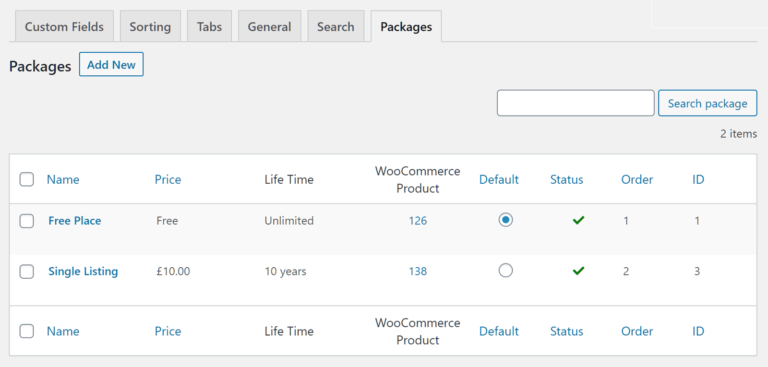
With the Pricing Manager add-on, you can monetize your directory in a range of ways. Examples include free trials that let visitors access premium features for a set time before signing up, recurring payment plans that collect fees at set intervals, and as many pricing packages as you want, each with its own settings and conditions.
Because the Pricing Manager add-on integrates with WooCommerce and GetPaid (the team's own invoicing plugin), you can automatically generate invoices for your paying users.
From a one-time fee for publishing a listing to recurring plans for ongoing access, the Pricing Manager add-on gives you what you need to monetize your online directory.
Create listings for business owners to claim
Creating listings yourself for the businesses you'd like on your website is one way to kickstart your directory. You can then make those listings claimable, so the owners of the featured companies can take charge and add extra information.
The premium Claim Listings add-on lets you create a listing for a local gym, for example, then let the gym's owner sign up and manage it. The benefit is that they can add useful content to help it appeal to their audience.
You can also use this add-on to add a verified badge to claimed listings for a more official look, and enable email notifications to keep everyone in the loop when a claim is started.
The Claim Listings add-on adds a claim button to claimable listings. It also integrates with the Pricing Manager add-on, so you can charge users a fee to take control of their listing.
Event management
While the core GeoDirectory plugin is ideal for publishing listings like businesses, attractions, or other places of interest, you can also use it to publish events. The Events add-on, which is now free, lets you create your own events promotion website with WordPress.
This add-on is packed with features, including recurring events, a calendar view that makes it easy for visitors to see what's coming up, and advanced filtering to help users find the events they're interested in. It has what you need to create an events listings website with WordPress.
BuddyPress integration
If you want to give your directory more of a community feel, you can add interactive features with the premium BuddyPress Integration add-on.
BuddyPress is a social networking plugin for WordPress, so this add-on lets you bring its interactive features into GeoDirectory. You can add discussion areas to your listings and let users create enhanced public profiles.
If you want to make your directory more engaging and a place users want to return to, social networking features via the BuddyPress integration can really help. Note that you'll need to pay to install this add-on.
The team has also added newer add-ons worth knowing about, including Booking Appointments (to take bookings directly from your listings) and MultiRatings & Reviews (for more detailed, multi-criteria reviews). You can view the full list on the plugin website.
WordPress themes

Another notable feature of the GeoDirectory plugin is that it works with any WordPress theme.
So if you already have a website set up with a reputable WordPress theme, you should be able to start using this plugin without any problems.
If you haven't chosen a theme yet, the GeoDirectory team has a few of their own built specifically for use with the plugin. Two of the free themes, Supreme and Whoop, are a good starting point.
There are free and paid options in their theme collection. You can buy the premium themes individually, but you get access to all of them, and all of the official add-ons, if you sign up for one of the GeoDirectory membership plans (more on those later).
GeoDirectory user experience
So far, our GeoDirectory review has given you an overview of the plugin's features and what it can do. Now let's explore what it's like to use, from both a website owner and an end-user perspective.
GeoDirectory admin user experience
If you're a website owner, the good news is that GeoDirectory is pretty easy to use. Because the core features are available via the free plugin, you can install it directly from your WordPress dashboard by searching the WordPress.org plugin directory.
Once installed and activated, a new menu item gives you access to the GeoDirectory control panel. If you buy any add-ons or sign up for a membership plan, you can enter your activation code in your WordPress dashboard, then install the add-ons you have access to. This saves you from downloading and uploading the individual add-on files.

You can also install any of the GeoDirectory themes you have access to directly from your WordPress dashboard in much the same way.
Setup wizard
GeoDirectory has a wizard that walks you through setting up your directory. This is very useful because the plugin has a lot of features that could otherwise feel overwhelming.
The wizard takes you through the essential steps so you don't miss any important tasks.

Dummy data
Unlike some premium WordPress themes, the GeoDirectory themes don't come with one-click demo importers that quickly apply demo content to your website. However, you can import some dummy listings into your directory to get a better idea of how the plugin works.

Also, two of the free GeoDirectory themes, Supreme and Whoop, come with guides and wizards to help you set up your site to look more like an online directory than a fresh WordPress install. It's not a one-click process, but the step-by-step approach gives you a lot of control over which demo settings and content get applied.

Another helpful touch is that admin hints are displayed as you navigate your directory. These are optional, but when you're new to GeoDirectory they can really help you understand how the system works at relevant points throughout your WordPress dashboard.
General settings
Because online directories come in all shapes and sizes, it's great to see that GeoDirectory, along with its themes and add-ons, can be heavily configured.

Everything from how new listing submissions are handled by default and which email notifications are sent automatically, to how the advanced search tool works and which locations are supported, can be configured through the GeoDirectory settings in your WordPress dashboard.
The more add-ons you install, the more options and settings you'll have. Combined with the high level of control you get over your listings site, that does mean there are a lot of settings to work through.

In addition to the tabs on the settings page, many of the panels have subpages with more controls. While it's great to have this much control over how your website works, you should be prepared to spend some time exploring all the options to set your directory up the way you want.
As you can see from the screenshots above, the GeoDirectory interface follows the WordPress approach to UI design. All of the controls integrate seamlessly into your WordPress dashboard, which saves you from learning a new way of working. Many of the settings also come with helpful tooltips and links to the relevant support documentation on the GeoDirectory website.
Creating and managing listings
Once you've configured the plugin, it's time to start creating listings for your directory. GeoDirectory uses custom post types to keep your directory content separate from the regular posts and pages on your website.
Using custom post types also lets your listings be presented differently from regular content and use additional fields to store extra data.

By default, the listings are called Places, although you can get more control over how your GeoDirectory content is stored by installing the premium Custom Post Types add-on.
As well as adding Places through your WordPress dashboard, you and your authorized visitors can add them through the GeoDirectory front-end forms.

Any listings submitted via the forms are handled according to your settings. They could be published immediately, or set to pending and held for manual approval.
As you can see, the admin experience has been well designed, and you get a lot of control over how your directory works.
Now let's take a look at the end-user experience to see what your directory will be like from a visitor's perspective.
GeoDirectory end-user experience
Your choice of theme plays a large role in how end-users experience your directory. As mentioned, there are free and paid themes available from the GeoDirectory team, so if you haven't chosen one yet, you don't need to worry about finding a suitable theme for your listings website.
Directory websites often use a map to display local listings with custom markers, followed by a search box. That's certainly one way to configure your website if you choose GeoDirectory and a compatible theme.

Using the core GeoDirectory functionality, visitors can zoom into the map and click on the markers to view listing details.
If you install the premium Custom Map Styles add-on, you get options for how the map is displayed. But even the free version of GeoDirectory has good Google Maps support.

When a visitor clicks through to an individual listing, they can view all the information that's been submitted. Again, your choice of theme dictates how listings look, but because GeoDirectory and its add-ons are very flexible, you get a lot of control over the appearance of your listings and the content they contain.
GeoDirectory also works with the best page builder plugins for WordPress and takes full advantage of the WordPress block editor. That means you can easily customize how the pages of your directory look through easy-to-use drag-and-drop interfaces.
GeoDirectory pricing
The core GeoDirectory plugin is free, with the add-ons available at a range of prices, including some free options like the Events add-on. You can buy premium add-ons individually, with most priced between $29 and $49 per year, or get access to all of them plus the themes through the GeoDirectory membership bundle.
At the time of writing, the all-add-ons membership bundle is $229 per year, which includes a year of support, updates, and any new add-ons released during that time. Every purchase comes with a 30-day money-back guarantee. Prices can change, so check the current pricing before you buy.
In most cases, you'll need at least one or two add-ons to build a fully functional directory site, so it's important to factor those costs in when comparing GeoDirectory against premium all-in-one WordPress directory themes.
GeoDirectory pros and cons
- Pros: free, powerful core plugin; built on custom database tables so it scales to large directories; flexible add-ons for locations, search, monetization, and events; works with any theme and the block editor; strong Google Maps and front-end submission support.
- Cons: a fully featured site usually means buying several add-ons, so costs add up; the sheer number of settings has a learning curve; the GeoDirectory themes lack one-click demo importers.
Frequently asked questions
What does GeoDirectory do?
GeoDirectory is a WordPress plugin for building directory and listings websites, such as local business directories, city guides, real estate listings, and job boards. It handles location-based search, Google Maps, and front-end listing submissions, and uses custom database tables so it stays fast even with thousands of listings.
Is GeoDirectory free?
Yes, the core GeoDirectory plugin is free on WordPress.org, and a few add-ons (like Events) are free too. Most premium add-ons are paid, so a fully featured directory usually costs something once you add the features you need.
How much does GeoDirectory cost?
The core plugin is free. Premium add-ons are mostly $29 to $49 per year individually, or you can get all of them plus the themes through the membership bundle, which is around $229 per year at the time of writing. Every purchase includes a 30-day money-back guarantee.
What can you build with GeoDirectory?
You can build local business directories, city and travel guides, real estate listings, job boards, classifieds, and event listings sites. Because listings don't have to be tied to a physical location, you can also create directories for freelancers, services, or members.
What is the difference between Directorist and GeoDirectory?
Both are WordPress directory plugins with a free core and paid extensions. GeoDirectory is built on custom database tables, which gives it an edge for large, location-heavy directories that need to stay fast at scale. Directorist is often praised for an approachable setup. The best choice comes down to the size of your directory and the specific features you need.
Conclusion
GeoDirectory has a powerful set of features for building professional directory and listings websites with WordPress.
While the core plugin is free, in most cases you'll need some of the premium add-ons to build the right type of website for your business. So it's worth looking past the free core plugin and exploring the add-ons to see which ones you're likely to need.
That said, GeoDirectory and its add-ons give you plenty of options for creating a listings directory with WordPress. Add-ons like the Events and Pricing Manager options make it easy to build an events directory and monetize your listings. The selection of themes is a nice bonus too.
So whether you want to add a directory to your existing WordPress website or start a new project, GeoDirectory, its add-ons, and its themes should give you everything you need.

Related Posts


